Benzocaine
Benzocaine is a local anesthetic used in pain control management, and it is in the ester local anesthetic class of medications. This activity describes the indications, action, and contraindications for benzocaine as a valuable agent in managing pain control. This activity will highlight the mechanism of action, adverse event profile, and other key factors (e.g., off-label uses, dosing, pharmacodynamics, pharmacokinetics, monitoring, relevant interactions) pertinent for members of the interprofessional team in the management of patients undergoing procedures requiring local anesthetic and pain control.
Objectives:
- Identify the indications for benzocaine use.
- Describe the most common adverse effects associated with benzocaine use.
- Summarize the risks associated with initiating benzocaine use.
- Outline the importance of improving care coordination amongst the interprofessional team to improve outcomes for patients receiving benzocaine.
Indications
Benzocaine is a commercially available local anesthetic. It is an amino ester and has uses in a variety of settings, including dental procedures, preparation for infiltrative anesthesia, and minor traumas. The primary purpose of using topical local anesthetics such as benzocaine is to reduce or relieve painful stimuli such as those caused by needle penetration. This anesthesia allows for more significant pain control and reduction of anxiety for the patient. Benzocaine gels, liquids, and lozenges are FDA approved. However, spray forms do not currently have FDA approval, and OTC oral drugs do not have authorization for children under two years of age and those prone to adverse effects indicated below.[1][2]
Mechanism of Action
Benzocaine functions by reversibly binding to and inhibiting sodium channels in the neuronal cell membrane. It first enters the cell in a nonionized form and then becomes ionized after traversing the membrane bilayer. Its ionized form then binds to the alpha subunit, inhibiting voltage-gated sodium channels. This binding stops cellular depolarization slows signal conduction, and decreases the ability of an action potential to arise. Local anesthetics such as benzocaine can bind more easily to sodium channels when they are in an open configuration. The pKa of benzocaine is relatively low (2.6) compared to other local anesthetics. The pKa of local anesthetics helps to determine the onset of action. The rate of action of benzocaine is fast and relatively pH-independent.
Administration
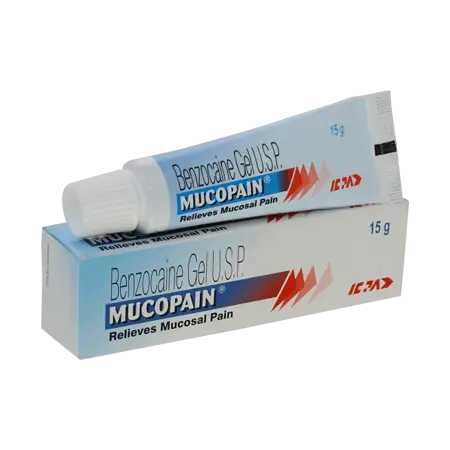
Benzocaine is available in many different forms, including solutions, lozenges, sprays, aerosols, creams, and gels. It is commercially available in solutions and sprays in 5%, 10%, or 20% concentrations. It can be applied topically to the desired area. The spray form of benzocaine can be useful for pain relief from sore throat and dental issues as well as medical procedures (awake intubation.)
Adverse Effects
Benzocaine is relatively safe and low-risk when applied topically. However, one of the more life-threatening side effects is methemoglobinemia, which is characterized by cyanosis, hypoxia, and dyspnea that do not improve with oxygen administration. This effect occurs due to benzocaine's ability to metabolize into nitrobenzene, which reduces the oxygen-binding capacity of hemoglobin by the oxidation of iron (Fe2+ to Fe3+). Other adverse effects include hypotension, bradycardia, cardiac arrest, convulsions, drowsiness, dizziness, edema, and allergic reactions.
Children and the elderly population are more prone to hypersensitivity reactions due to benzocaine. Therefore, benzocaine should be used with caution as it may cause tenderness, itchiness, and edema to the applied area. Though benzocaine is a relatively low-risk medication, some patients may experience sensitization to the drug. Topical benzocaine usage is not recommended in patients that have deep wounds, lesions, or severe burns.
Benzocaine topical spray is dosed for ages 12 and older as needed, a maximum of four times a day.
Contraindications
Benzocaine is contraindicated in patients with severe allergic reactions to ester-type local anesthetics. Additionally, benzocaine application is contraindicated in individuals with heart arrhythmias, a history of methemoglobinemia, G6PD deficiency, and decreased lung function. Numerous reports have indicated that patients with predisposing medical conditions such as COPD, emphysema, or coronary artery disease have a higher incidence of developing methemoglobinemia when given benzocaine as a local anesthetic. Patients with a history of significant type IV reactions to local anesthetics should be screened before the application of benzocaine. Caution is also necessary for patients with significant skin trauma, edema, and infections. Benzocaine is contraindicated in children under the age of 2 because of the risk of methemoglobinemia. Studies have also suggested that the risk of developing methemoglobinemia increases by almost twenty-fold if a patient has suffered benzocaine exposure within the previous week.
Benzocaine is categorized as a pregnancy category C drug, meaning that there are no studies to demonstrate safety during pregnancy. Researchers have noted cough and sore throat products containing benzocaine to be relatively safe to use during breastfeeding.
Monitoring
The World Federation of Societies of Anesthesiologists (WFSA) recommends continuous ECG in evaluating cardiac function and consistent monitoring of blood pressure and pulse oximetry for proper tissue oxygenation in the body. It is also vital to assess carbon dioxide levels in the body to prevent any neurological side effects. Intermittent monitoring of urine output (renal function) is essential in determining the proper clearance of benzocaine out of the body. In addition to the above, a routine CBC is necessary to evaluate for any hemolysis in cases of suspected underlying methemoglobinemia.
Toxicity
If the clinical staff suspects early signs of toxic methemoglobinemia in a patient after the use of benzocaine, supplemental oxygen and IV administration of a 1% solution of methylene blue are the recommended treatment. The dose is repeatable if no clinical improvement has occurred within the first hour of administration. Caution is necessary if administering a dose greater than 7 mg/kg; this can worsen symptoms of methemoglobinemia. Ascorbic acid can also be given for suspected methemoglobinemia but has a slower action compared to methylene blue.
When used in a pain control regimen, one of the rarer life-threatening complications of benzocaine toxicity is local anesthetic systemic toxicity syndrome (LAST). Several case studies have shown that the fundamental mechanism of LAST depends on several factors causing an overall decreased function in the cardiovascular system, as well as the central nervous system. These may include cardiac arrest or bradycardia, severe hypotension, and cardiac arrhythmias.
Toxicity symptoms may also involve convulsive syncope and seizures in patients after using local anesthetics, especially in the elderly population. Several case study analyses suggest prompt use of lipid emulsion therapy (20%) when there is suspicion of a seizure or a cardiovascular event in the patient. If a seizure due to benzocaine toxicity is suspected, the first step is airway management, followed by controlling the seizure and stabilizing hemodynamics.
Enhancing Healthcare Team Outcomes
Benzocaine is administered in various forms for pain control and used in procedures such as awake intubations and transesophageal echocardiography. It is crucial for interprofessional healthcare team members who perform these procedures and administer benzocaine to work in a coordinated manner. Nurses, pharmacists, clinicians (MDs, DOs, NPs, PAs), and other healthcare workers involved in patient care should be well aware of the toxicity and adverse effects of benzocaine such as methemoglobinemia and communicate in an interprofessional team manner to ensure effective therapy and prevent toxicity or adverse events. In the case of suspected methemoglobinemia, a medical toxicologist should be present and involved in the patient's care. With an interprofessional team approach, patients can receive the pain relief they need with a reduced potential for adverse events, leading to better patient outcomes.
-
Buy Product
You can buy product by clicking
- Buy Now